Optimization Series: Mastering the Transfer Bonus Window
A limited-time transfer bonus can meaningfully change which program gives you the most miles for your points , but only if you have a redemption available before you move your points.

Transfer bonuses are among the most time-sensitive opportunities in the points-and-miles world. They are short-term promotions and easy to miss. But when a bonus aligns with a trip you are already planning, it can stretch your points balance considerably.
What is a transfer bonus?
When you transfer points from a bank loyalty program (Amex Membership Rewards, Chase Ultimate Rewards, Citi ThankYou Points and others) to an airline or hotel program, the standard ratio is 1:1. Transfer 1,000 Chase points to United MileagePlus and you will receive 1,000 United miles.
During a transfer bonus, the receiving program deposits extra points on top. A 20% bonus from Chase to Air Canada Aeroplan, for example, means that 1,000 Chase points become 1,200 Aeroplan points instead of the usual 1,000.
The bonus applies to the points received, not the points sent.
Some bonuses are clearly displayed in the bank’s portal during the transfer process. Others are offered by the airline or hotel program and post after the transfer arrives. Before moving points, read the terms carefully to confirm where the bonus comes from and when it should post.
Why programs run transfer bonuses
A transfer bonus is essentially a sale co-sponsored by your bank and an airline or hotel. The airlines and hotels use them to attract new travelers, while banks use them to keep you engaged with your credit card.
Not every partner participates. Some (World of Hyatt, United MileagePlus, Delta SkyMiles, and American AAdvantage) rarely or never appear with public bonuses. If a partner has offered bonuses before, waiting briefly for another transfer bonus window can make sense. But if a partner rarely participates, holding out for a bonus is unlikely to pay off.
This is one reason flexible points are more useful when they are diversified across more than one bank program. Chase, Amex, Capital One, Citi and Bilt do not always run the same bonuses at the same time, and their partner lists overlap partially. A traveler with more than one transferable currency may have more ways to reach the same airline or hotel program when a useful promotion appears.
Recent transfer-bonus patterns
The table below shows which programs appear most frequently with public transfer bonuses and which ones are rare.
Transfer-bonus history, last two years
The chart is historical, not a recommendation to wait for a future bonus. Avios transfers include British Airways, Iberia, Aer Lingus, Qatar Airways, and Finnair (as Avios can be moved between these accounts at a 1:1 ratio). Offers can be targeted, extended, or changed, so confirm the promotion inside your own transfer portal before moving points.
Flight award example
To see how a bonus changes a booking decision, consider a nonstop New York to Zurich flight on SWISS. Two of SWISS's Star Alliance partners — United MileagePlus and Air Canada Aeroplan — can book this route, and both accept transfers from Chase Ultimate Rewards at 1:1.
The default comparison
| Program | Miles required | Chase points to transfer | Taxes & fees (approx.) |
|---|---|---|---|
| United MileagePlus | 44,000 miles | 44,000 | $5.60 |
| Air Canada Aeroplan | 35,000 miles | 35,000 | CAD 69 (~$58) |
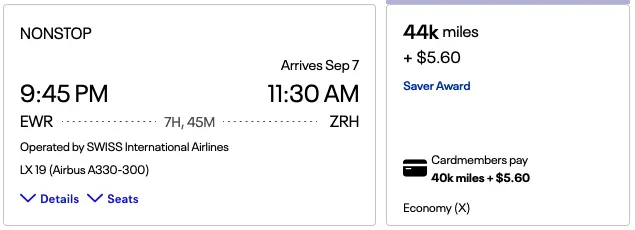
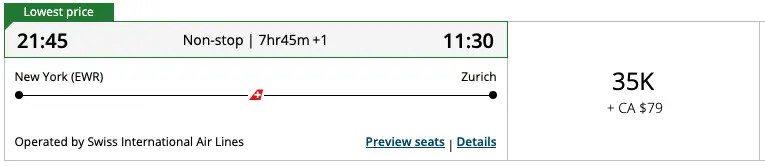
Without a bonus, Aeroplan costs fewer miles but significantly higher fees. United costs more miles but keeps fees near zero.
How a 20% Aeroplan bonus changes the math
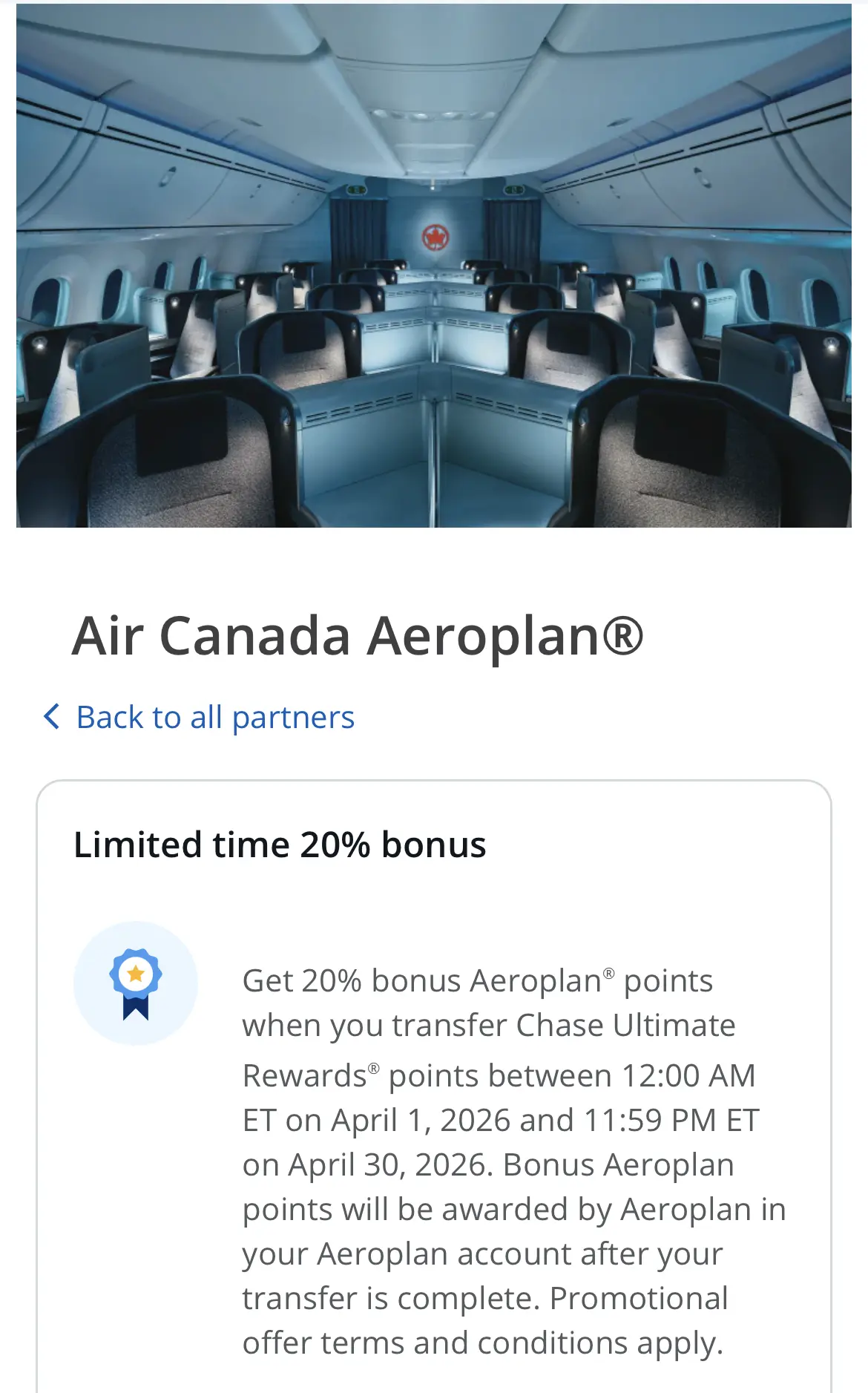
In April 2026, Chase offered a 20% transfer bonus to Air Canada Aeroplan. Every 1,000 Chase points became 1,200 Aeroplan miles. At that rate, covering the 35,000-mile award requires only 29,167 Chase points, which rounds up to 30,000 in Chase's 1,000-point transfer increments.
Here is how all three scenarios compare for one passenger:
| Scenario | Chase points needed | Miles received | Taxes & fees | Chase points saved vs. United |
|---|---|---|---|---|
| United (no bonus available) | 44,000 | 44,000 United miles | ~$6 | — |
| Aeroplan (no bonus) | 35,000 | 35,000 Aeroplan miles | ~$58 | 9,000 |
| Aeroplan (20% bonus) | 30,000 | 36,000 Aeroplan miles | ~$58 | 14,000 |
The advantage grows when booking for multiple passengers. For two travelers, the Aeroplan route requires 70,000 miles. With the 20% bonus, that translates to 58,334 Chase points, which rounds up to 59,000. The United route would require 88,000 Chase points for two seats — a gap of 29,000 points saved for the identical flights on the same aircraft.
Hotel award example
Bonuses also change the math for hotel programs. Amex to Hilton normally converts at 1:2. A 20% bonus raises that to 1:2.4, meaning fewer Membership Rewards points cover the same award.
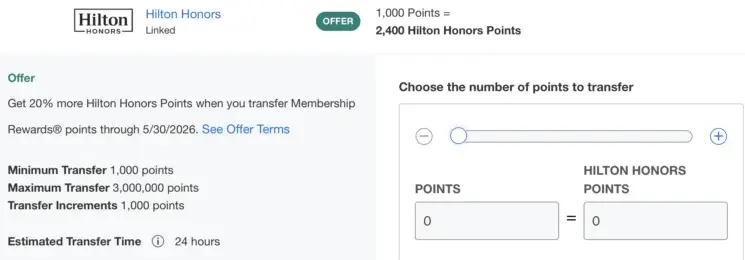
For a 90,000-point stay:
| Scenario | Transfer ratio | Amex points needed | Hilton points received | Points saved |
|---|---|---|---|---|
| Without bonus | 1:2 | 45,000 | 90,000 | — |
| With 20% bonus | 1:2.4 | 37,500 | 90,000 | 7,500 |
The most important rule: have a redemption confirmed before you transfer
Moving points only because a bonus is available, without a specific booking in mind is a speculative transfer. Once points leave your bank account, the transaction is irreversible: they are now locked into that specific airline or hotel program. If award space disappears or a program devalues its chart before you book, your points lose significant flexibility and may even be subject to that partner's expiration rules.
Bank points are flexible, airline and hotel points are not
How to evaluate whether a bonus is worth using
Work through four questions before transferring:
1. Do you have a specific redemption identified and confirmed as available? If the answer is no, stop. The bonus percentage is irrelevant without a destination and confirmed availability.
2. Does the bonus change which option gives you the best value? Run the math on your actual itinerary. In the EWR–ZRH example, the 20% bonus reduced Chase points needed from 44,000 to 30,000, turning Aeroplan from the secondary choice into the more efficient one.
3. What does depleting this balance cost you? If you are close to having enough points for another redemption you care about — a different trip, a hotel stay, a spending threshold — transferring your bank points now may interrupt that plan.
4. Can another bank currency reach the same partner? Some programs are transfer partners of multiple banks. Before moving points, check whether the airline or hotel program can also be reached from another transferable currency you hold. That matters when one bank has a bonus, another has a better transfer ratio, or you want to preserve a specific points balance for a future use.
When a transfer bonus is not worth taking
A transfer bonus can create a false sense of urgency. A 40% bonus on a poor redemption is still a poor redemption. Before acting, compare the cost through the bonus program against what the same trip costs through a stronger partner. If the comparison does not favor the bonus program even with the extra miles, the offer is not for you.
We can see an example with hotel transfers. Chase transfers to Marriott and IHG can look more interesting when a bonus appears, but the underlying value may still be weak compared with transferring Chase points to World of Hyatt or airlines.
IHG points can often be purchased for roughly 0.5 to 0.56 cents each, and award stays (when you use those points for a redemption) average around the same value. Therefore, transferring 1 Chase point at 1:1 to IHG turns a flexible point into something worth around half a cent.
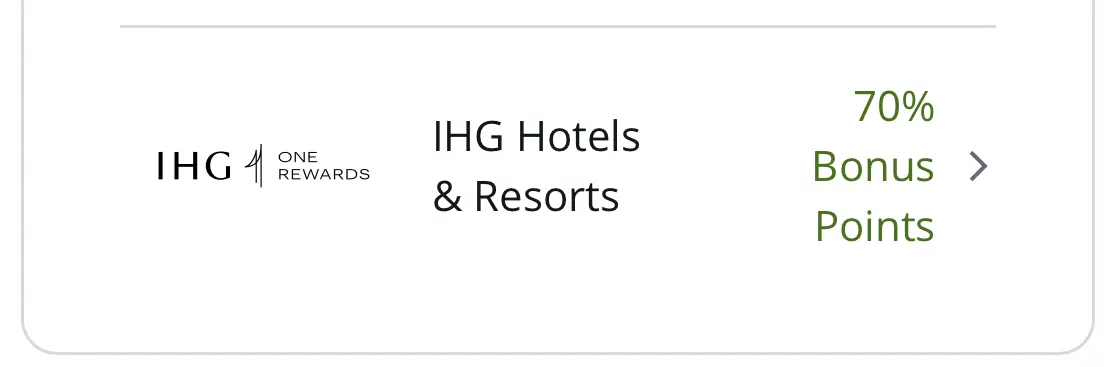
A 70% transfer bonus improves the math — 1 Chase point becomes 1.7 IHG points, worth roughly 0.85 cents at that IHG average. That is better than the standard IHG transfer, but still well below the 1.5 to 2 cents per point that a strong airline redemption or Hyatt stay often produces. The bonus helps, but it does not automatically make a weak transfer strong.
The Checklist: When a Bonus is Actually a "Go"
When a transfer bonus aligns with your travel plans, it is a deal worth taking, but the order of operations is critical.
-
01
Identify the trip
Start with the trip you want to book, including the destination, approximate dates, and number of travelers.
-
02
Confirm availability
Search for award space and confirm the flight seat or hotel night is bookable at the price you expect.
-
03
Prepare the booking details
Have your travel dates, passenger details, and loyalty account information ready before you move any points.
-
04
Transfer the points
Move only the amount you need, rounded up to the nearest transfer increment required by your bank program.
-
05
Book immediately
Complete the award booking as soon as the transfer posts, which is often within a few minutes but can vary by program.
How to calculate the points to transfer with a bonus
For the Air Canada Aeroplan example:
- Start with the award price: 35,000 Aeroplan miles
- Convert the 20% bonus into a multiplier: 1.20
- Divide the award price by the multiplier: 35,000 ÷ 1.20 = 29,167 Chase points
- Round up to the nearest transfer increment: 30,000 Chase points
The general formula: Partner points needed ÷ bonus multiplier = bank points to transfer
Round the result up to the nearest increment for your bank program: 1,000 points for Chase, Amex, Citi, and Bilt; 100 miles for Capital One, or any amount for Wells Fargo. For a 20% Chase-to-Aeroplan bonus, use 1.20. For a 20% Amex-to-Hilton bonus, use 2.4 (the base 1:2 ratio × 1.20). For a 70% Chase-to-IHG bonus, use 1.70.
Points transfer calculator
Use the calculator below to estimate how many bank points to transfer based on the points you need in your airline or hotel account. Set the transfer-ratio slider to the effective ratio after the bonus: 1,200 for a 20% Chase-to-Aeroplan bonus, 2,400 for a 20% Amex-to-Hilton bonus, or 1,700 for a 70% Chase-to-IHG bonus.
Transfer bonuses reward travelers who already have a specific redemption confirmed. Find the award first, run the math with the current bonus applied, and transfer only when both conditions are met.